| Episode number | MB35 (Part 35 of 42) |
|---|---|
| Original air date | February 8, 1994 |
| Broadcast | Hour of the Time, WWCR shortwave |
| Chapter title | From Babylon to Christianity |
| Primary text read on air | Babylon Mystery Religion: Ancient and Modern by Ralph Woodrow (1981) |
| Listen | Stream the series on archive.org |
Episode Summary
Episode 35 aired on February 8, 1994, and was unplanned in the sense that Cooper had arranged a guest for the evening, the guest did not call in, and Cooper went to what he called plan B: reading from Ralph Woodrow’s 1981 book Babylon Mystery Religion: Ancient and Modern. Cooper recommends alongside it Alexander Hislop’s The Two Babylons, which he describes as essential reading for anyone who has followed the series. He notes that the Woodrow book largely synthesizes Hislop. The episode carries a quality of personal urgency; Cooper delivers an extended peroration in his own voice about truth, organized religion, and the conditions for human freedom that runs for several minutes after he closes the Woodrow text.
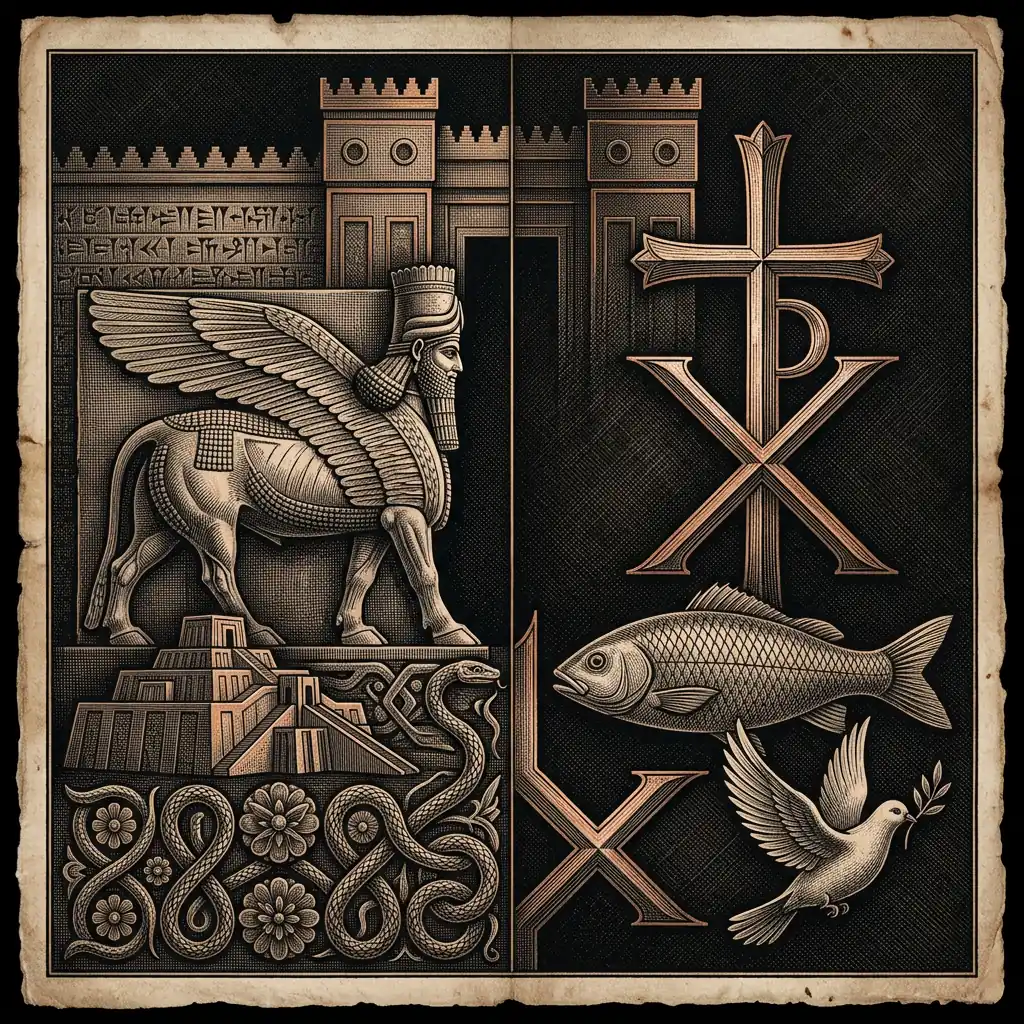
The episode opens the Woodrow book at its beginning, reading the passage from Revelation 17 that names the great harlot Mystery Babylon, and then tracing the historical origin of that mystery religion to the ancient city of Babylon in the land of Shinar, between the Tigris and Euphrates rivers. Woodrow’s argument, endorsed by Cooper without reservation, is that the religious system that originated in Babylon spread to every civilization on Earth and that it is still present in every major religion today, including Christianity, in the form of practices, symbols, and doctrines that were pagan in origin and were absorbed rather than eliminated.
The central figure in Woodrow’s account is Nimrod, whom the Genesis record identifies as the grandson of Ham and the founder of Babel. Woodrow draws on the Jewish historian Josephus, who wrote that Nimrod gradually changed the government into tyranny and directed the building of the Tower of Babel, and on the Jewish Encyclopedia, which defines Nimrod as one who made all the people rebellious against God. Cooper interrupts to connect the name Nimrod, derived from the Hebrew verb marad meaning to rebel, with Lucifer, noting that both figures are defined by their rebellion against God, and to observe that those who built the Tower were called the Builders, a title he has traced through the entire series to the present day.
The mythology that developed around Nimrod’s death is the core of Woodrow’s chapter. When Nimrod died, his body was cut into pieces, burned, and sent to various areas. His wife Semiramis claimed he had become the sun-god, and when she subsequently gave birth to a son, Tammuz, she claimed the child was Nimrod reborn, supernaturally conceived. She identified Tammuz as the promised seed, the savior, fulfilling the earliest messianic prophecy. The religion that developed worshiped both mother and child. Cooper identifies this as the first recorded virgin birth claim and traces the mother-and-child worship through every subsequent mystery religion, with Semiramis becoming the Goddess of the Sea, whose name Mary, from the Latin mare, sea, was later applied to the Virgin Mary in Roman Christianity.
The episode then documents the global spread of Babylonian religion after the dispersal from the Tower of Babel. Woodrow quotes the ancient historian Herodotus, who witnessed the mystery religion across multiple countries and identified Babylon as its primeval source; Bunsen, who concluded that Egyptian religion derived from the primitive empire in Babel; and Layard, who found in his excavation of Nineveh the united testimony of sacred and profane history that idolatry originated in Babylonia. These quotations, Cooper notes, are all drawn from Hislop’s The Two Babylons.
Rome receives particular attention. When Rome became a world empire, it absorbed the gods and religions of every country it conquered, and since Babylon was the source of all those national religions, pagan Rome was already Babylonish at its foundation. Into this environment, Cooper argues, the true church of Jesus Christ was born. He distinguishes sharply between the early church of the book of Acts, in which all members were saints and equal, and the organized religion that followed. The Emperor Constantine’s profession of Christianity is described not as a genuine conversion but as a political calculation: Rome was about to fall and Constantine adopted Christianity to save the empire. Cooper argues that Constantine was in fact a sun worshiper who never accepted Jesus as savior, that the double-headed eagle symbol of the Roman Empire appears today on the walls of the Vatican and on the seal of the 33rd degree of Freemasonry, and that the Roman Emperor became the Pope as the Roman Empire became the Roman Catholic Church.
Cooper’s extended closing address moves beyond the Woodrow text. He argues that the mystery schools and the Vatican are both pursuing world government but differ only on who will rule: the mystery schools want a council of elders with a puppet leader on a world throne, while the Vatican wants the Pope to sit on that throne. He calls the American people the odd card in this contest, the joker in the deck, with the capacity to choose neither outcome and reinstitute what he calls the real church as Jesus taught it. He charges that organized religions of every denomination have incorporated Babylonian doctrines and are preparing their congregations for submission to the New World Order. He urges listeners to read Hislop’s The Two Babylons and the Woodrow book, and to refer to the full run of the Mystery Babylon series.
Key Claims Made in This Episode
Documented from the broadcast. The site records these claims; it does not endorse them. Dated claims also appear in the series timeline.
- Cooper claims that Nimrod of Babylon, whose name derives from the Hebrew marad meaning to rebel, was the first organizer of cities and kingdoms, directed the building of the Tower of Babel, and was identified in the Jewish Encyclopedia as one who made all the people rebellious against God.
- Cooper claims that after Nimrod’s death his wife Semiramis claimed he had become the sun-god, and that her son Tammuz, claimed to be Nimrod reborn, constitutes the first recorded virgin birth claim and the prototype for all subsequent mother-and-child worship in world religion.
- Cooper claims that the title Mary, applied to the Virgin Mary in Roman Christianity, derives from the Latin mare, sea, and from the Babylonian title Goddess of the Sea applied to Semiramis, demonstrating direct continuity between Babylonian and Catholic religious symbolism.
- Cooper claims the ancient historians Herodotus, Bunsen, and Layard all independently testified that idolatry originated in ancient Babylon and spread from there to every civilization on earth, as documented by Alexander Hislop in The Two Babylons.
- Cooper claims that those who built the Tower of Babel were called the Builders, and that this same organization and title persists in the secret societies of the present day.
- Cooper claims Emperor Constantine was a sun worshiper who never genuinely converted to Christianity, that his adoption of the faith was a political measure to save the Roman Empire from collapse, and that the Roman Emperor became the Pope as the Roman Empire transformed into the Roman Catholic Church.
- Cooper claims the double-headed eagle, symbol of the Roman Empire signifying rule over east and west, still appears on the walls of the Vatican and is the symbol of the 33rd degree of Freemasonry, demonstrating an unbroken institutional connection between Rome, the Church, and the highest Masonic degree.
- Cooper claims that all organized Christian denominations have incorporated Babylonian doctrines into their teachings and are actively participating in preparing their congregations for submission to the coming New World Order.
- Cooper claims the mystery schools and the Vatican share the goal of world government but disagree only on who will hold the throne: the mystery schools want a council of elders with a visible puppet leader, while the Vatican wants the Pope to hold supreme power directly.
Primary Sources Cited in This Episode
| Source | Status | Where to find it |
|---|---|---|
| Ralph Woodrow, Babylon Mystery Religion: Ancient and Modern (1981) | Not public domain; read at length on air, treated here under quotation only | Library copies; see sources hub |
| Alexander Hislop, The Two Babylons (1853, expanded 1858) | Public domain | Search archive.org |
| Josephus, Antiquities of the Jews (c. AD 93-94), cited via Woodrow for the Nimrod account | Public domain | Search archive.org |
| Genesis chapters 10 and 11 (King James Bible), Revelation chapter 17 (cited directly by Cooper) | Public domain | Available at every library and archive |
| Romans chapter 1, verses 21 through 26 (King James Bible), read from Woodrow text | Public domain | Available at every library and archive |
| Herodotus, The Histories (5th century BC), cited via Woodrow as a witness to the mystery religion | Public domain | Search archive.org |
Notable Quotes
Those who built the Tower are now called the Builders. And they still exist, ladies and gentlemen, today.
Cooper, MB35, February 8, 1994
We are the odd card, the joker in the deck. For if we want to, we could decide that neither one of them will rule, and we could determine the outcome of this battle.
Cooper, MB35, February 8, 1994
Historians’ View
The Hislop and Woodrow framework has been assessed critically by historians of religion and biblical scholars. Alexander Hislop’s The Two Babylons is a nineteenth-century polemical work whose central thesis, that Catholicism is the direct heir of Babylonian paganism through Nimrod and Semiramis, is rejected by the consensus of ancient Near Eastern historians and religious scholars. The figures of Semiramis as Nimrod’s wife and Tammuz as their son are not attested together in ancient Babylonian sources in the way Hislop describes; the composite mythology Hislop constructs draws on traditions separated by centuries and geography. Ralph Woodrow, the author Cooper reads in this episode, subsequently wrote a partial retraction of the book in the 1990s, acknowledging that he had followed Hislop’s methodology too uncritically. The claim that Constantine was never a Christian is debated among historians; the standard position is that his conversion was genuine but theologically unsophisticated by later standards. The claim that the double-headed eagle connects the Vatican to Freemasonry to Rome in an unbroken institutional line is an assertion of conspiracy; historians trace the double-headed eagle as a heraldic symbol adopted by multiple independent institutions. We record all claims as broadcast; we do not endorse them.
Frequently Asked Questions
What is Mystery Babylon episode 35 about?
Episode 35 reads the opening chapters of Ralph Woodrow’s Babylon Mystery Religion to trace the origin of the Mystery Babylon religion from Nimrod and Semiramis through every world religion to the Roman Catholic Church, arguing that the same Babylonian theology persists in all organized religions today and is being used to prepare humanity for submission to a world government. The episode connects directly to the Mystery Schools and Ancient Religion hub.
Who was Ralph Woodrow and why does Cooper recommend his book?
Ralph Woodrow was an American evangelical Christian author who wrote Babylon Mystery Religion in 1981, drawing heavily on Alexander Hislop’s nineteenth-century work The Two Babylons. Cooper treats both books as essential reading for the series. Woodrow later published a partial retraction called The Babylon Connection, acknowledging methodological problems in the Hislop framework he had relied upon. The original 1981 book is what Cooper reads on air. See the sources hub for further context.
What is The Two Babylons by Alexander Hislop?
The Two Babylons (1853, expanded 1858) is a polemical work arguing that Roman Catholic practices and symbols derive from the mystery religion of ancient Babylon, centered on the worship of Nimrod, Semiramis, and Tammuz. It is public domain and available via archive.org. Cooper recommends it throughout the series and considers it foundational to understanding the Mystery Babylon thesis. Critical assessments are noted in the sources hub.

Where can I listen to episode 35?
The series is preserved at archive.org. The site never hosts or distributes the audio; see our content policy.
Continue the Series
- Previous: MB34: Secret Societies and Vatican II
- Next: MB36: Rose Cross Part 1
- Topic hub: Mystery Schools and Ancient Religion
- Related hub: Secret Societies
- Related hub: Luciferian Doctrine and New Age
- Every dated claim from this episode: series timeline
- Full index: Mystery Babylon complete episode guide
- Background: Who was William Cooper?
- Primary sources cited: Mystery Babylon sources hub
