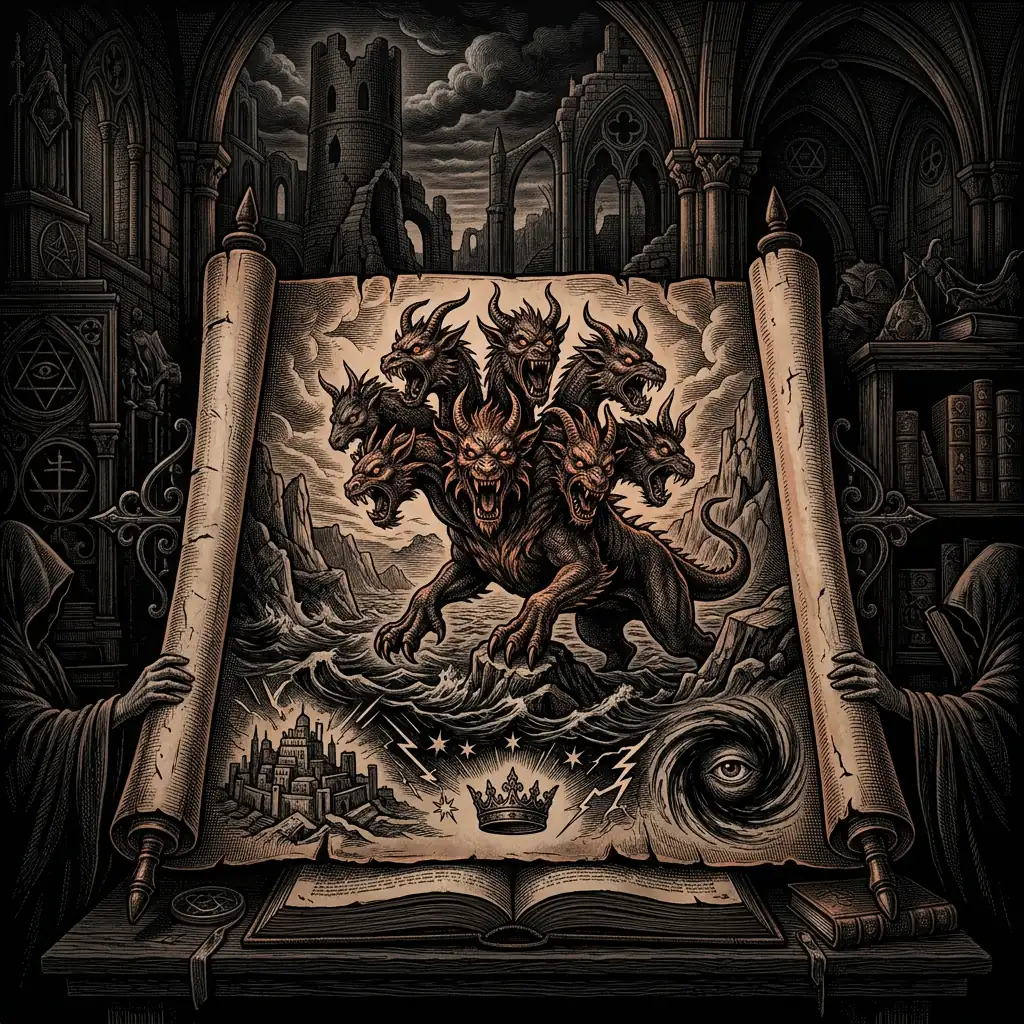
The phrase Mystery Babylon comes from a single verse in the King James Bible, Revelation 17:5, where John describes a woman seen in a vision: "And upon her forehead was a name written, MYSTERY, BABYLON THE GREAT, THE MOTHER OF HARLOTS AND ABOMINATIONS OF THE EARTH." Few images in scripture have generated more interpretation. For nearly two thousand years, readers have asked who or what this figure represents, and the answers have shaped whole traditions of Christian thought. This page walks through what Revelation 17 and 18 actually say, surveys the major interpretive traditions fairly, and then explains how a 1990s radio series borrowed the phrase for a very different purpose. All Bible quotations are from the King James Version, which is in the public domain.
The Text: Revelation 17
Revelation 17 opens with one of the seven angels inviting John to see a judgment: "Come hither; I will shew unto thee the judgment of the great whore that sitteth upon many waters: With whom the kings of the earth have committed fornication" (Revelation 17:1-2). Carried away in the spirit into the wilderness, John sees a woman seated on a scarlet beast that has seven heads and ten horns, and is "full of names of blasphemy" (17:3).
The description of the woman is dense with imagery: "And the woman was arrayed in purple and scarlet colour, and decked with gold and precious stones and pearls, having a golden cup in her hand full of abominations and filthiness of her fornication" (Revelation 17:4). Then comes the name on her forehead, the verse from which everything on this page descends, identifying her as Mystery, Babylon the Great. John adds a darker detail: "And I saw the woman drunken with the blood of the saints, and with the blood of the martyrs of Jesus" (17:6).
The chapter then does something unusual for apocalyptic literature: the angel interprets the vision within the text itself. The seven heads of the beast are "seven mountains, on which the woman sitteth" (17:9), and also seven kings. The ten horns are ten kings who will receive power with the beast, make war against the Lamb, and ultimately turn on the woman and destroy her. The chapter closes with the angel’s most concrete statement: "And the woman which thou sawest is that great city, which reigneth over the kings of the earth" (Revelation 17:18).
The Text: Revelation 18
Revelation 18 announces the fall of the city the woman represents. An angel cries, "Babylon the great is fallen, is fallen, and is become the habitation of devils, and the hold of every foul spirit" (Revelation 18:2). A voice from heaven issues the chapter’s most quoted summons: "Come out of her, my people, that ye be not partakers of her sins, and that ye receive not of her plagues" (18:4).
What follows is a lament with a strikingly economic character. The kings of the earth mourn her burning, and so do the merchants, "for no man buyeth their merchandise any more" (Revelation 18:11). The text inventories that merchandise across several verses: gold, silver, fine linen, ivory, spices, wine, livestock, "and slaves, and souls of men" (18:13). Babylon in chapter 18 is not only a religious figure but a commercial power, a hub of world trade whose fall ruins those who grew rich by her. The chapter ends with a millstone thrown into the sea as a sign of finality: the city will be found "no more at all."
The Old Testament Background
Revelation’s Babylon imagery is not invented from nothing; it is assembled from older scripture. Babylon enters the biblical story at the tower of Babel in Genesis 11 and becomes, after the destruction of Jerusalem and the exile of Judah in the sixth century BC, the Bible’s standing symbol of idolatrous imperial power. The prophets supply nearly every image John uses. Isaiah 21:9 already contains the cry "Babylon is fallen, is fallen." Jeremiah 51:7 describes Babylon as "a golden cup in the LORD’s hand, that made all the earth drunken," the direct ancestor of the cup in the woman’s hand. Jeremiah also pleads, "flee out of the midst of Babylon" (51:6), anticipating the call to come out of her.
By the first century, the literal city of Babylon was a fading provincial town. That is precisely why most scholars across all interpretive camps agree on one point: in Revelation, Babylon is a cipher, a code name for something else. The disagreement, and it is a deep one, is over what the code points to.
The Major Interpretive Traditions
Christian interpreters have read Mystery Babylon in several distinct ways. The summaries below are a neutral survey; each tradition has serious scholars and a long pedigree, and this site does not adjudicate among them.
The Preterist Reading: A First-Century Referent
Preterist interpreters hold that Revelation spoke primarily to its original audience about events of its own era. On the most common preterist reading, Babylon is Rome: the city on seven hills (matching the seven mountains of 17:9), the imperial power that taxed the world’s trade and persecuted the early church. The fact that 1 Peter 5:13 sends greetings from "the church that is at Babylon," widely understood as a code for Rome, supports the view that first-century Christians already used the name this way. A minority preterist position identifies Babylon instead with first-century Jerusalem, reading the harlot imagery against the prophets’ marriage language for the covenant city and the judgment as the destruction of AD 70.
The Historicist Reading: The Sweep of Church History
Historicist interpreters read Revelation as a panorama of history unfolding between the apostles and the end. In this tradition, dominant among the Protestant Reformers, Babylon was identified with the Roman church and the papacy: a religious power, arrayed in scarlet and purple, seated in the city of seven hills, accused of corrupting the faith and persecuting dissenters. Luther, Calvin, Knox, and the major Reformation confessions read the passage this way, and the identification shaped centuries of Protestant polemic. Modern historicism survives most prominently in Seventh-day Adventist interpretation, which reads Babylon as a composite of apostate religious systems and the call to "come out of her" as a present-tense summons. Catholic interpreters have answered this entire tradition since the Reformation, typically with preterist or futurist counter-readings.
The Futurist Reading: A Power Yet to Come
Futurist interpreters place the fulfillment of Revelation 17 and 18 in a still-future period of end-time events. On this reading, common in evangelical prophecy teaching since the nineteenth century, Mystery Babylon is an end-time system, religious in chapter 17 and commercial in chapter 18, that will dominate the world before the return of Christ. Futurists divide over specifics: some expect a literal rebuilt Babylon on the Euphrates, citing prophecies of Babylon’s destruction that they argue were never exhaustively fulfilled; others expect a future world religious confederation or a great end-time city, with Rome, Jerusalem, and other candidates proposed. What unites the tradition is the conviction that the woman and the beast describe real entities that have not yet appeared in final form.
The Idealist Reading: A Symbol for Every Age
Idealist interpreters read Revelation’s images as portraits of permanent spiritual realities rather than coded references to particular institutions. On this reading, Babylon is the perennial human city organized against God: seductive, wealthy, violent, and doomed, whether it wears the face of ancient Babylon, imperial Rome, or any later power. The call to come out of her is addressed to every generation. Many modern commentators blend this view with the preterist one: Rome is the immediate referent, and Rome is also the type of every Babylon to come.
How Bill Cooper’s Mystery Babylon Series Used the Term
In 1993, shortwave broadcaster William Cooper borrowed this phrase as the title of a 42-episode radio series on his program The Hour of the Time. Readers arriving here from Bible study should understand that Cooper’s use of the term sits outside all four traditions above.
Cooper did not primarily treat Mystery Babylon as a city, a church, or an end-time empire. In the series, the phrase names what he called the Mystery Religion of ancient Babylon: the initiatory cults of the ancient world, with their sun worship, staged initiations, and guarded secrets. Cooper claimed this religion never died. The series argues that its doctrines passed through the Gnostics, the medieval Assassins, the Knights Templar, the Rosicrucians, and Freemasonry, and that its initiates pursue, in his words and in the words of the writers he quoted, a unified world order. Where the biblical text presents Babylon as a power to be judged at history’s end, Cooper presented Mystery Babylon as a continuing institution operating in secret throughout history. The scarlet woman of Revelation 17 appears in his telling less as prophecy than as identification: a biblical portrait, he claimed, of the religion he was describing.
It is a genuinely different use of the term, and search engines mix the two audiences together, which is partly why this page exists. The biblical figure belongs to the study of scripture and its interpretive history. Cooper’s thesis belongs to the study of twentieth-century conspiracy culture and its sources. Mainstream historians do not accept his continuous-lineage claim, and the series should be approached as a primary document of its genre rather than as biblical scholarship. Cooper did engage the religious material directly in places; his episode on the claimed migration of Babylonian forms into church practice drew on Alexander Hislop’s nineteenth-century book The Two Babylons, a work modern scholarship treats as methodologically unsound, which our episode guide for that broadcast discusses.
If you want to evaluate Cooper’s argument for yourself, the place to start is our complete Mystery Babylon episode guide, which indexes all 42 broadcasts with air dates, original summaries, and free streaming links to the original audio on archive.org. Background on the broadcaster, including his career and death, is on our William Cooper biography page. The series’ claims about specific organizations are collected in topic hubs, including Freemasonry and secret societies, each documented against the sources Cooper read from.
Reading the Passage Well
A few orientation points serve readers of every persuasion:
- Read chapters 17 and 18 together. Chapter 17 presents the woman and her judgment in religious terms; chapter 18 presents the same fall in economic terms. Interpretations that use only one chapter tend to flatten the figure.
- Note the interpreted elements. The text itself decodes some symbols (seven heads as seven mountains and seven kings, the woman as the great city, the waters as peoples and nations in 17:15). Any interpretation has to account for the decoding the angel already supplies.
- Weigh the Old Testament echoes. The golden cup, the fallen cry, and the call to flee all come from the prophets’ oracles against historical Babylon. The figure is built to be recognized by readers who know Isaiah and Jeremiah.
- Distinguish text from tradition. The identifications surveyed above, Rome, the papacy, a future world system, the perennial wicked city, are interpretations with histories. Knowing which tradition a commentator stands in clarifies what is argument and what is assumption.

Frequently Asked Questions
What does Mystery Babylon mean in the Bible?
It is the name written on the forehead of the woman in Revelation 17:5 (KJV): "MYSTERY, BABYLON THE GREAT, THE MOTHER OF HARLOTS AND ABOMINATIONS OF THE EARTH." In the vision she is a wealthy, persecuting power seated on a seven-headed beast, identified by the angel as "that great city, which reigneth over the kings of the earth" (17:18). Interpreters differ on what the city represents.
Who is Mystery Babylon in Revelation 17?
There is no single agreed answer. Preterist interpreters generally identify her with first-century Rome (a minority say Jerusalem). The Reformation-era historicist tradition identified her with the Roman church. Futurists expect an end-time religious and commercial system, sometimes a literally rebuilt Babylon. Idealists read her as the perennial human city in rebellion against God.
Where is Mystery Babylon mentioned in the KJV?
The name appears in Revelation 17:5. The figure dominates Revelation 17 and 18, and Babylon is also named in Revelation 14:8 and 16:19, where her fall is announced in advance. The background imagery comes from Isaiah 21 and Jeremiah 50 and 51, the prophets’ oracles against historical Babylon.
Is Mystery Babylon a city, a religion, or a system?
The text calls her a city (Revelation 17:18), but a city portrayed in religious terms in chapter 17 and commercial terms in chapter 18. Most traditions therefore treat her as a power that is at once civic, religious, and economic, and disagree about which historical or future entity fits that portrait.
Why did Bill Cooper call his radio series Mystery Babylon?
Cooper borrowed the phrase from Revelation 17:5 as a label for what he claimed was a surviving ancient mystery religion carried through secret societies into the modern world. His usage differs from the standard interpretive traditions, which read the figure as a city or world system under judgment. The series is indexed in our complete episode guide.
Does the Mystery Babylon series teach a standard Christian interpretation of Revelation?
No. Cooper’s series argues a secret-societies thesis about history rather than offering an exegesis of Revelation 17 and 18, although Cooper, who spoke as a Christian, returned to biblical themes throughout. Readers interested in the standard interpretations will find them surveyed on this page; readers interested in Cooper’s argument should start with the episode guide and the sources he read from.
