| Episode number | MB30 (Part 30 of 42) |
|---|---|
| Original air date | October 18, 1993 |
| Broadcast | Hour of the Time, WWCR shortwave |
| Chapter title | United Nations Meditation Room |
| Primary text read on air | The Cult of the All-Seeing Eye by Robert Spenser (1960) |
| Listen | Stream the series on archive.org |
Episode Summary
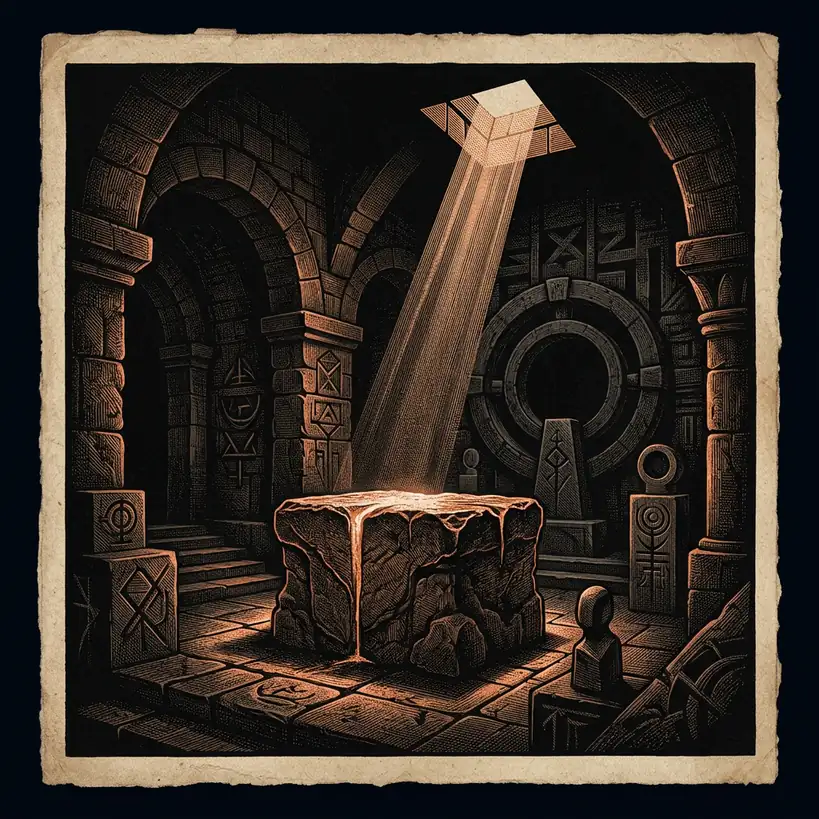
Episode 30 aired on October 18, 1993, and presents the United Nations Meditation Room in New York City as a working occult temple installed at the center of the world’s governing body. Cooper reads nearly the entire relevant portion of Robert Spenser’s 1960 book The Cult of the All-Seeing Eye, using Spenser’s detailed physical description and symbolic analysis of the room to build what he calls concrete evidence of the godlessness and esoteric intent behind the United Nations.
Spenser’s account begins with the room’s architecture. The space is wedge-shaped, thirty feet long and tapering from eighteen feet at the entrance to nine feet at the far wall. Its only light source is a beam focused from a ceiling lens onto a six-and-a-half-ton block of crystalline iron ore, the largest magnetite ever mined, donated by the Swedish government in 1957. The room’s acoustic design, its blue-grey slate floor, and the corridor of near-total darkness that precedes entry are all described in careful physical detail before Spenser turns to their symbolic meaning.
The centerpiece of Cooper’s analysis is the official leaflet written under the direction of Secretary-General Dag Hammarskjold to describe the room. Cooper reads the leaflet’s language closely, noting terms he argues are meaningful to initiates but opaque to outsiders. The leaflet describes the stone altar as dedicated to the God whom man worships under many names and in many forms. Cooper identifies this as the esoteric formulation of the Mystery Religion’s universal god, identical to the solar deity tracked through earlier episodes.
Cooper then introduces the Lucis Trust, the organization that published the World Goodwill Bulletin describing the room in glowing terms. He reads Spenser’s account of the Trust’s history: it was established by Alice A. Bailey as the Lucifer Publishing Company, and changed its name on November 11, 1924 to the Lucis Publishing Company. Bailey, described as the High Priestess of the Arcane School, ran an organization Cooper identifies as a society of self-described Illumined Minds with intimate connections to the United Nations. John D. Rockefeller Jr. is identified as the most important financial patron of the Friends of the Meditation Room, contributing to its construction and furnishing over more than two decades.
The symbolic analysis of the fresco mural painted by Bo Beskow at Hammarskjold’s direction occupies the episode’s final third. Spenser’s analysis finds a nine-cell magic square whose numbers sum to 15 in every direction, corresponding to the numerical value of the Hebrew word JAH, one of the forms of the Tetragrammaton. He counts 72 geometric figures in the mural, corresponding to the 72-word divine name derived from Exodus chapters 14 and 19-21. The spiral line intertwined with the mural’s diagonal is identified as the Caduceus of Hermes, and the bisected sphere as the all-seeing eye. An inverted black triangle is read as a symbol of Lucifer.
Cooper interjects at several points to connect these symbols to arguments made in earlier episodes. The dot-in-circle hidden within the crescent form he identifies as the phallic symbol of Freemasonry and the generative force of the Mystery Religion. The room’s orientation, entered from darkness and proceeding toward light, matches the Masonic and initiatory symbolic progression he has described throughout the series. He closes by asserting that viewed from above, the mural forms the truncated top of a pyramid, with a smaller pyramid behind the mural containing the all-seeing eye of Lucifer, and that this architecture was not accidental but deliberate.
Key Claims Made in This Episode
Documented from the broadcast. The site records these claims; it does not endorse them. Dated claims also appear in the series timeline.
- Cooper claims the United Nations Meditation Room was deliberately designed as an occult temple, with its architecture, altar, and mural encoding esoteric symbols of sun worship, the all-seeing eye, and the generative force of the Mystery Religion.
- Cooper claims that the organization that published promotional material about the Meditation Room, the Lucis Trust, was originally incorporated as the Lucifer Publishing Company and changed its name on November 11, 1924.
- Cooper claims that Alice A. Bailey, founder of the Arcane School and Lucis Trust, described her organization as a society of Illumined Minds with intimate connections to the United Nations.
- Cooper claims that John D. Rockefeller Jr. was the most important financial patron of the Friends of the Meditation Room, contributing to the room’s construction and furnishing over more than twenty years.
- Cooper claims that the fresco mural in the Meditation Room contains a nine-cell magic square whose values sum to 15 in every direction, and that 15 is the numerical value of the Hebrew name JAH, one of the forms of the Tetragrammaton.
- Cooper claims that the mural contains exactly 72 geometric figures corresponding to the 72-word divine name derived from Exodus, and 22 triangles corresponding to the 22 letters of the Hebrew alphabet.
- Cooper claims that the spiral line in the mural represents the Caduceus of Hermes, that its ninth arc encodes the serpent symbol, and that the number 666 cabalistically reduces to nine, the number of generation.
- Cooper claims that Dag Hammarskjold described the altar as a cornerstone and that this description encodes Masonic symbolism of the path from darkness to light and the Stone of Foundation described in Cabalistic and Masonic texts.
- Cooper claims that pressure from organizations including the World Council of Churches was brought to bear on Secretary-General Trygve Lie to establish the room, and that Lie announced it on April 18, 1949.
- Cooper claims that viewed from directly above, the mural forms the truncated top of a pyramid, with a smaller pyramid behind it containing the all-seeing eye of Lucifer.
Primary Sources Cited in This Episode
| Source | Status | Where to find it |
|---|---|---|
| Robert Spenser, The Cult of the All-Seeing Eye (1960) | Not public domain; read at length on air, treated here under quotation only | Library copies; see sources hub |
| Dag Hammarskjold, official UN leaflet describing the Meditation Room (1957) | UN document; public domain | United Nations archives; sources hub |
| World Goodwill Bulletin, Lucis Trust, special UN edition (July 1957) | Not public domain; quoted within Spenser | Library copies; sources hub |
| Alice A. Bailey, writings of the Arcane School (cited by Spenser) | Various dates; most Bailey titles published 1922-1954; copyright status varies by title | Library copies; see sources hub for individual titles |
| P. D. Ouspensky, writings on objective art (cited by Spenser) | Quoted within Spenser; individual works vary by publication date | Library copies; sources hub |
| M. Oldfield Howey, The Encircled Serpent (1928) | Public domain | Search archive.org |
| Alfred Edward Waite, The Secret Doctrine of Israel (1913) | Public domain | Search archive.org |
| Manly P. Hall, The Secret Destiny of America (1944) (referenced in closing) | Not public domain; referenced by Spenser | Library copies; sources hub |
Notable Quotes
The stone in the middle of the room has more to tell us. We may see it as an altar, empty not because there is no God, not because it is an altar to an unknown god, but because it is dedicated to the God whom man worships under many names and in many forms.
Cooper, MB30, October 18, 1993, reading from the official UN Meditation Room leaflet written under Hammarskjold’s direction
Historians’ View
The factual details of the Meditation Room’s construction, funding, and design are accurately drawn from public record. Dag Hammarskjold did direct the room’s redesign in 1957, the six-and-a-half-ton magnetite block was donated by Sweden that year, and Bo Beskow did paint the mural. The Lucis Trust was indeed incorporated as the Lucifer Publishing Company and did change its name in 1924; the organization maintains a consultative relationship with the United Nations Economic and Social Council. John D. Rockefeller Jr.’s financial support for the Friends of the Meditation Room is documented. The symbolic analysis of the mural drawing on numerology, Cabalistic number mysticism, and Masonic symbolism is Spenser’s and Cooper’s interpretive framework, not the artist’s stated intent; Beskow said his fresco contained no intentional symbols. Scholars of the United Nations and of New Thought spirituality do not find evidence that the room was designed as an initiatory temple, and Hammarskjold’s own writings on the room emphasize universalist ecumenical intent rather than occult programming. We record all claims as broadcast; we do not endorse them.
Frequently Asked Questions
What is Mystery Babylon episode 30 about?
Episode 30 presents the United Nations Meditation Room as an occult temple at the heart of the world’s governing body. Cooper reads from Robert Spenser’s The Cult of the All-Seeing Eye and the room’s official UN leaflet to argue that the room’s architecture, magnetite altar, and fresco mural encode sun worship, Masonic symbolism, and Cabalistic numerology. The episode connects to the Luciferian doctrine thread through the Lucis Trust, covered also in the Luciferian Doctrine and New Age hub.
What is the Lucis Trust and what is its connection to the UN?
The Lucis Trust is the organization founded by occultist Alice A. Bailey. Cooper’s source notes that it was originally called the Lucifer Publishing Company before changing its name in November 1924. It maintains a consultative status with the UN Economic and Social Council. Cooper identifies it as a society of self-described Illumined Minds whose publications framed the Meditation Room in esoteric terms. See the Luciferian Doctrine hub for related episodes.
What is the magnetite altar in the UN Meditation Room?
The altar is a six-and-a-half-ton block of crystalline iron ore, donated by Sweden in 1957. It weighs approximately 6.5 tons and rests on a concrete pillar set directly on bedrock. Spenser’s analysis, which Cooper reads, identifies it as a lodestone or magnetite with occult properties, and connects it to ancient traditions of stone worship and the Masonic Stone of Foundation. The UN’s own leaflet describes it as dedicated to the God whom man worships under many names.
Where can I listen to episode 30?
The series is preserved at archive.org. The site never hosts or distributes the audio; see our content policy.
Continue the Series
- Previous: MB29: The Godmakers
- Next: MB31: Ice: The Ultimate Disaster
- Topic hub: Luciferian Doctrine and New Age
- Related hub: Secret Societies
- Freemasonry symbolism thread: Freemasonry
- Every dated claim from this episode: series timeline
- Full index: Mystery Babylon complete episode guide
- Sources cited: Mystery Babylon sources hub
